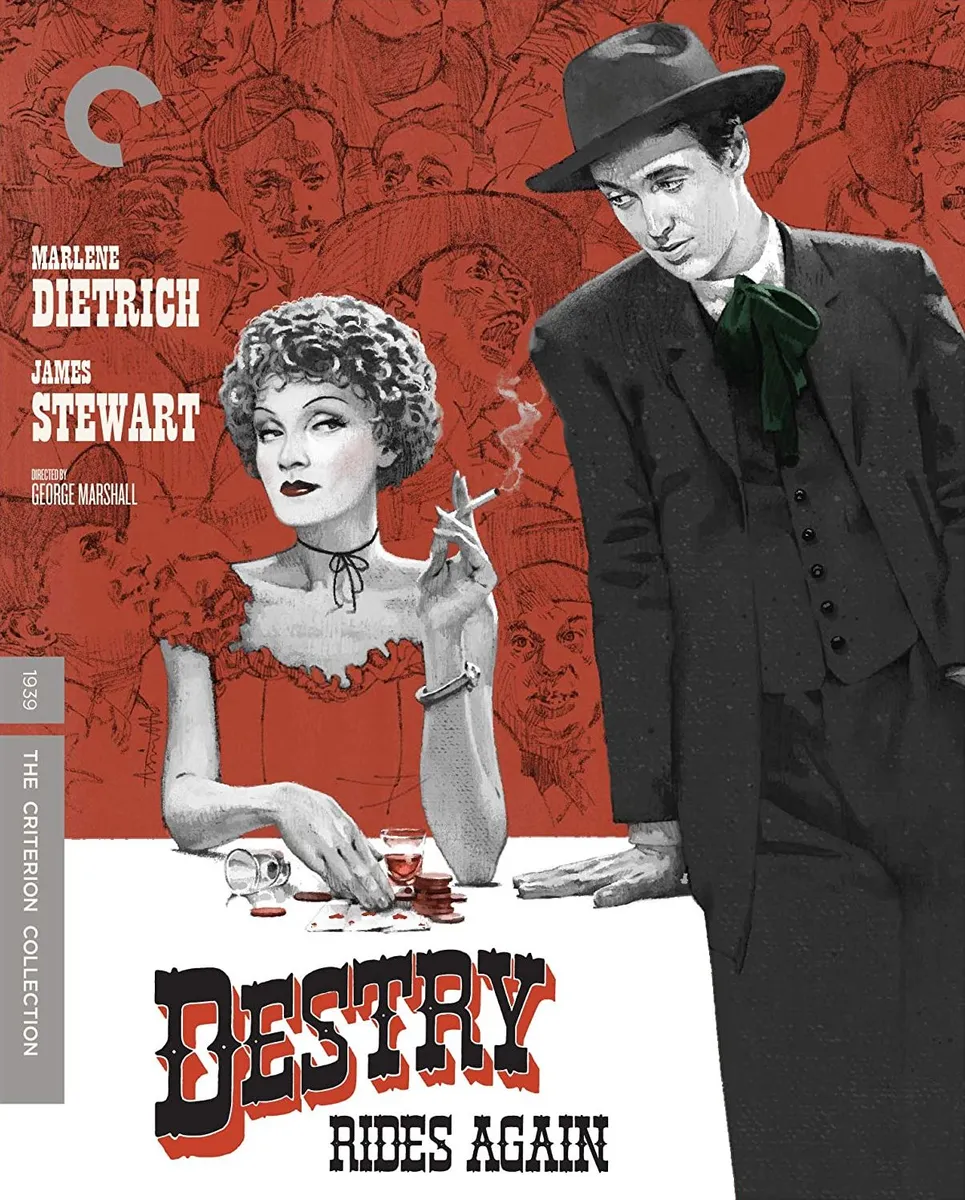
About this release
"In this mix of action and humor, Destry (Stewart) returns to the wide-open town of Bottleneck which his late father once tamed. His challenge is to enforce the law using his belief in nonviolence. Now Kent (Donlevy) and his cronies have run wild, cheating at high-stakes poker, tempting working men away from their families, charging trail herds for passage, and forcing honest people off their land. Dietrich does a classic turn as Frenchie, a saloon girl as ready to brawl as to perform her memorably sexy and comic ""See What the Boys in the Backroom Will Have"" or the light-hearted ""Little Joe,"" which is also sung by Wash Dimsdale (Winninger), who is an old friend of Destry's father, the town drunk, and now Destry's deputy. As Destry searches for the killer of the previous sheriff, he also braces Frenchie about her ethical failures in a couple of serious scenes that give depth and character to a film that is primarily action and humor. When Jack Carson amasses the good men in town for a final violent showdown against the villains and their henchmen, the plot takes a proto-feminist twist when the Frenchie challenges the good women of Bottleneck to march between both mobs armed with house and farm implements to take matters into their own hands. As the women resolve the town's conflict in a huge saloon brawl, Frenchie takes a bullet meant for Destry from Kent. In one of the final moments of the denouement, a boy and a girl happily reprise ""Little Joe"" in the bright sunlight, a touching reminder that the lives of Frenchie and Wash were part of the cost of a peaceful town. This film of course predates Stewart's tour in the Army Air Corps as part of a bombing crew during World War II. In this era, he played strong-willed, principled, but largely nonviolent roles. The tough westerners of ""Winchester '73"" and ""The Far Country"" remained in the future. The issues of women's roles and the challenge of nonviolence in a violent milieu, both respected contemporary subjects, are usually ignored in regard to this film. Made in the stellar Hollywood year of 1939, its memory has been overshadowed by the other great films of the same year, including John Ford's immortal ""Stagecoach."""
Where to buy
As an Amazon Associate and eBay Partner Network member, FilmShelves earns from qualifying purchases. These links may earn us a commission at no extra cost to you.
Disc 1
BD
Destry Rides Again (1939)
94 min
ComedyWestern
Tom Destry, son of a legendary frontier peacekeeper, doesn’t believe in gunplay. Thus he becomes the object of widespread ridicule when he rides into the wide-open town of Bottleneck, the personal fiefdom of the crooked Kent.
Credits
Director
George Marshall
Writer
Gertrude Purcell
Henry Myers
Felix Jackson
Cast
James Stewartas Tom Destry Jr.
Marlene Dietrichas Frenchy
Mischa Aueras Boris
Charles Winningeras Washington Dimsdale
Brian Donlevyas Kent
Allen Jenkinsas Gyp Watson
Warren Hymeras Bugs Watson
Irene Herveyas Janice Tyndall
Una Merkelas Lily Belle
Billy Gilbertas Loupgerou
Cinematographer
Hal Mohr
Composer
Frank Skinner
Editor
Milton Carruth
Producer
Joe Pasternak
Images
Release Details
- Packaging
- Blu-ray Case
Catalogue Info
- Added by
- Matthew Simpson
- Date added
- June 10, 2026