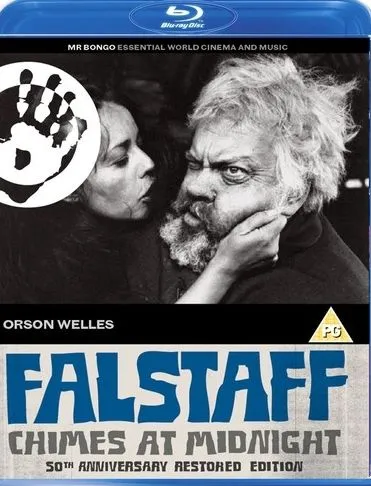

About this release
The legendary Shakespearean character Sir John Falstaff, the notoriously drunken, obese, and yet charming companion of the young Henry V, steps up from supporting character in several plays to the central focus of Orson Welles' Chimes at Midnight, considered by many critics the best of the director's acclaimed Shakespeare films. The script borrows scenes from several plays, but draws most heavily on the two parts of Henry IV, focusing on the shifting relationship between Falstaff and Prince Hal. Beginning as the prince's companion in debauchery and idleness, the corpulent jokester finds himself falling out of favor as the prince comes to terms with the importance of his destiny as England's future leader. While Falstaff's ample wit is still much in evidence, the film places greater emphasis on the tragic character beneath all the joviality, with Welles perfectly embodying this mixture of spiritually youthful prankster and sad adult. While his towering performance naturally takes center stage, the other cast members are also superb. The film's visual elements are also strong, with Welles' attention to composition matching his sensitivity to character. There are technical imperfections due to the film's extremely limited budget, including an inconsistent soundtrack, but they are unable to overshadow the film's many achievements.
Where to buy
As an Amazon Associate and eBay Partner Network member, FilmShelves earns from qualifying purchases. These links may earn us a commission at no extra cost to you.
Disc 1
BDImages
Release Details
- Packaging
- Blu-ray Case
Catalogue Info
- Added by
- Matthew Simpson
- Date added
- August 2, 2026