About this release
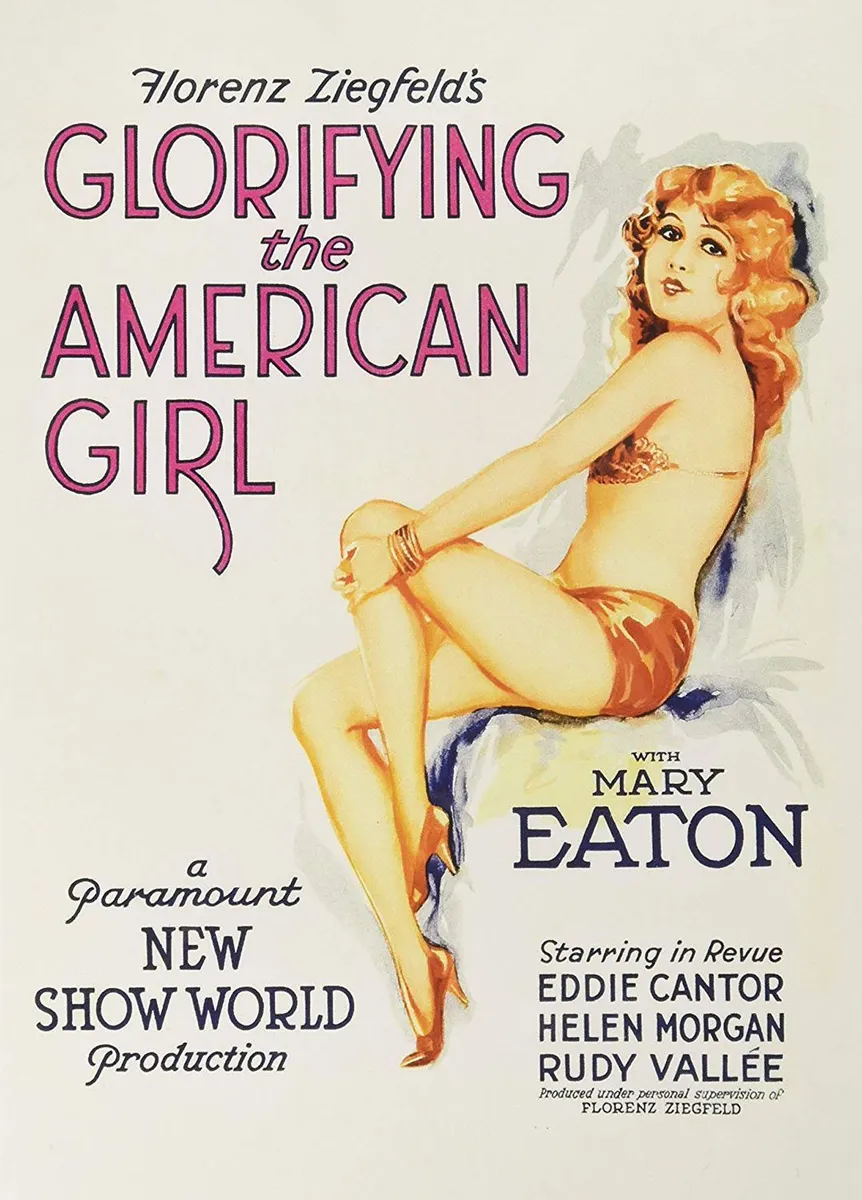
Broadway impresario Florenz Ziegfeld brought his legendary "Follies" to the silver screen in Glorifying the American Girl. The barely visible plotline concerns a virginal young miss (Mary Eaton) who aspires to greatness as a Follies girl. With stars in her eyes, she heads to New York, leaving her hometown boyfriend to fend for himself. Upon arriving in the Big Apple, our heroine links up with a two-bit dancer who offers to make her a star -- if only she'll let him make her, period. The greater part of the film is given over to a re-creation of a "typical" Follies production, replete with musical solos by Rudy Vallee and Helen Morgan and a sidesplitting comedy sketch with Eddie Cantor and Louis Sorin as a pair of kvetching Jewish tailors ("Vat's der idea uff calling me a damn fool in front uff der customers?" "So, it's a secret?"). From time to time, the camera cuts away to the many celebrities enjoying the show, including journalist Ring Lardner, nightclub doyenne Texas Guinan, New York mayor Jimmy Walker, Paramount Pictures head man Adolph Zukor, and Flo Ziegfeld himself, accompanied by his then-wife, Billie Burke. And yes, that's Johnny Weissmuller on-stage as a provocatively undraped "Nature Boy." As a bonus, the musical score was the handiwork of Irving Berlin. Originally filmed in Technicolor, Glorifying the American Girl is presently available only in black-and-white.
Where to buy
As an Amazon Associate and eBay Partner Network member, FilmShelves earns from qualifying purchases. These links may earn us a commission at no extra cost to you.
Disc 1
DVD
Glorifying the American Girl (1929)
95 min
ComedyMusic
A young woman, who wants to be in the Follies, is making ends meet by working at a department store's sheet music department, where she sings the latest hits. She is accompanied on piano by her childhood boyfriend, who is in love with her, despite her single-minded interest in her career. When a vaudeville performer asks her to join him as his new partner, she sees it as an opportunity to make her dream come true. Upon arriving in New York City, our heroine finds out that her new partner is only interested in sleeping with her and makes this a condition of making her a star. Soon, however, she is discovered by a representative of Ziegfeld.
Credits
Director
Millard Webb
Cast
Mary Eatonas Gloria Hughes
Eddie Cantoras Self
Helen Morganas Self
Rudy Valleeas Self
Dan Healyas Miller
Kaye Renardas Mooney
Edward Crandallas Buddy
Gloria Sheaas Barbara
Sarah Edwardsas Mrs. Hughes
Noah Beeryas Self (uncredited)
Cinematographer
George J. Folsey
Producer
Monta Bell
Release Details
- Packaging
- Keep Case
Images
Catalogue Info
- Added by
- Matthew Simpson
- Date added
- June 24, 2026